Hello, I’ll Be Your Interviewer
An AI that runs the first interview.
A hiring team can only run so many first interviews. ForFirm runs them all — in four languages, any hour, consistently.
A hiring team can only run so many first interviews. ForFirm runs them as a real, spoken conversation — in four languages — and hands the recruiter a video, a transcript, and a weighted score instead of an hour on a call. I joined at the kickoff and owned the design, the frontend, and the integrations.
- What it is — an AI voice-interview platform: a candidate flow and a recruiter back office.
- My role — from the first co-design call through design, frontend, and the Manatal + Microsoft integrations.
- The shape — deliberately narrow: create the interview, run it, review it. Everything else stays in the tools the team already uses.
I came to the first call with a full platform mapped out — open positions, candidates, templates, a calendar. About twelve minutes in, the team stopped me: they didn’t want any recruiting workflow inside the product. That lives in their ATS and their own future tool; the AI should just run the interview. So I redrew the structure live and cut the scope to three things — create an interview, run it, review it.
- “It has to be a second me” — the brief: the AI conducts the first interview so the recruiter doesn’t have to.
- Cutting scope this early was the most important design decision — it kept the product focused and buildable.
Before designing a screen, I mapped every step — for both people in the room.
- A one-shot link by email
- A landing that sets who, role and what’s next
- Tech check — mic, camera, connection
- GDPR + recording consent
- Meets the AI interviewer
- Answers role-based questions by voice
- Pauses & drop-outs handled gracefully
- Thank-you & clear next steps
- Told who follows up, and when
- Builds an interview from a JD or from scratch
- Sets language, duration and weights
- Generates the candidate’s link
- Interview runs unattended
- Alerted if a candidate drops out
- Video + transcript + weighted score
- AI summary and red flags
- Exports a report for the hiring manager
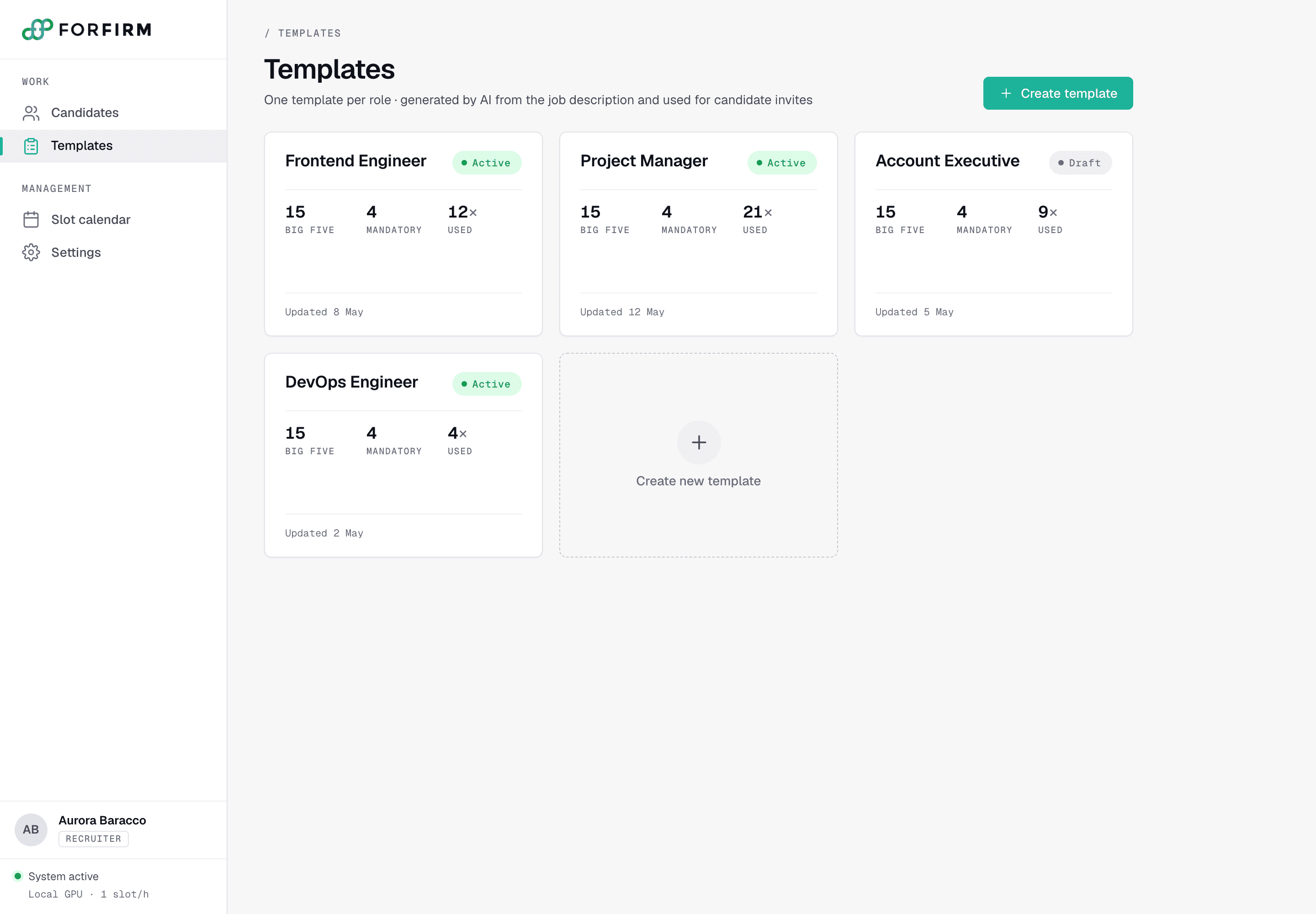
The interview is built from reusable, language-agnostic templates — generated from a job description or from scratch — so one template serves every market. A recruiter configures each interview: which questions, in which language, and how much each answer weighs in the final score.
- Language is set by the recruiter per position, not chosen by the candidate — because the interview also shows whether someone can hold a conversation in the language they’ll work in.
- Weighted scoring: each question carries a weight, so the final score reflects what actually matters for the role.
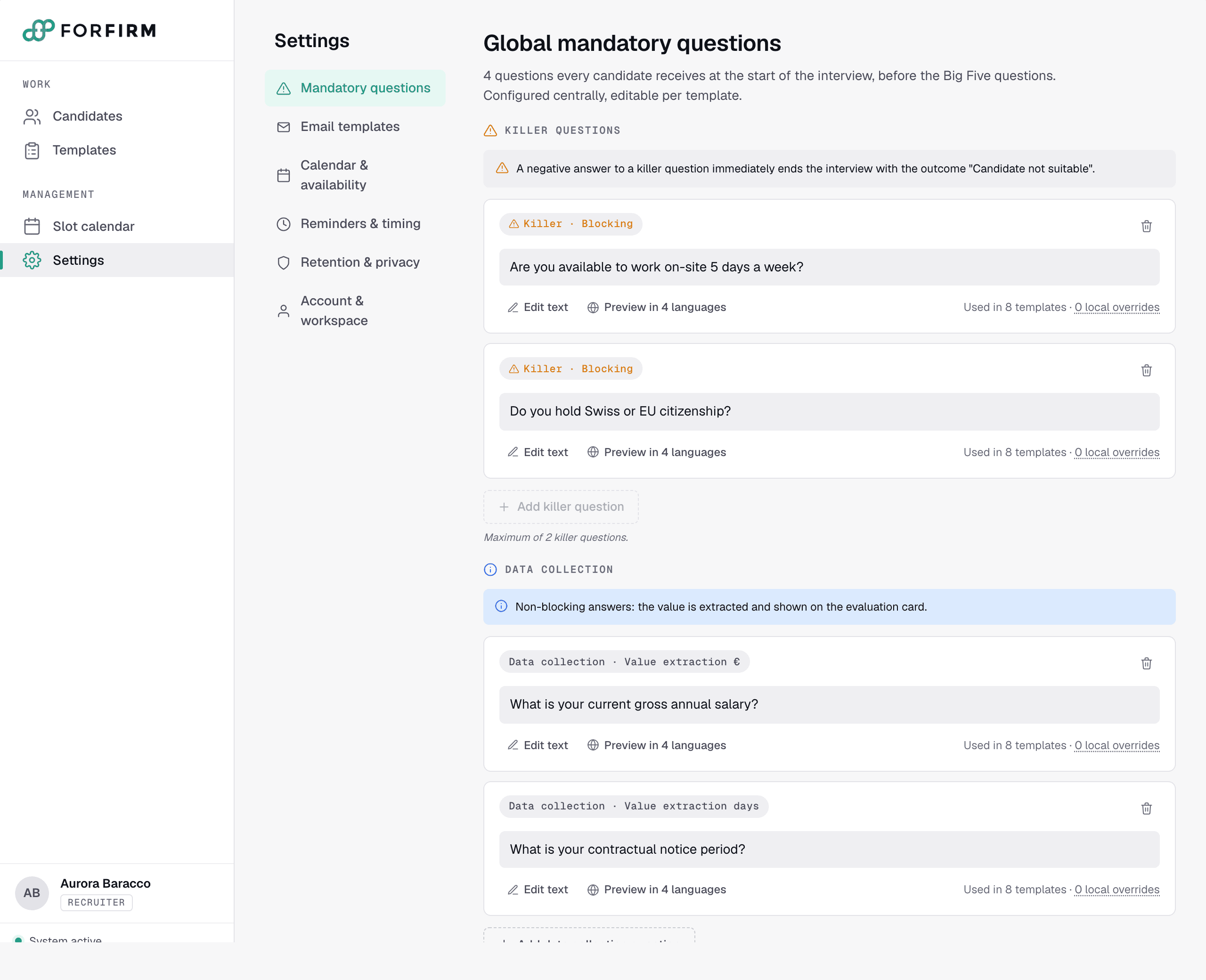
- A configuration dashboard for the whole question set — killer questions and data-collection questions, tunable globally or per template.
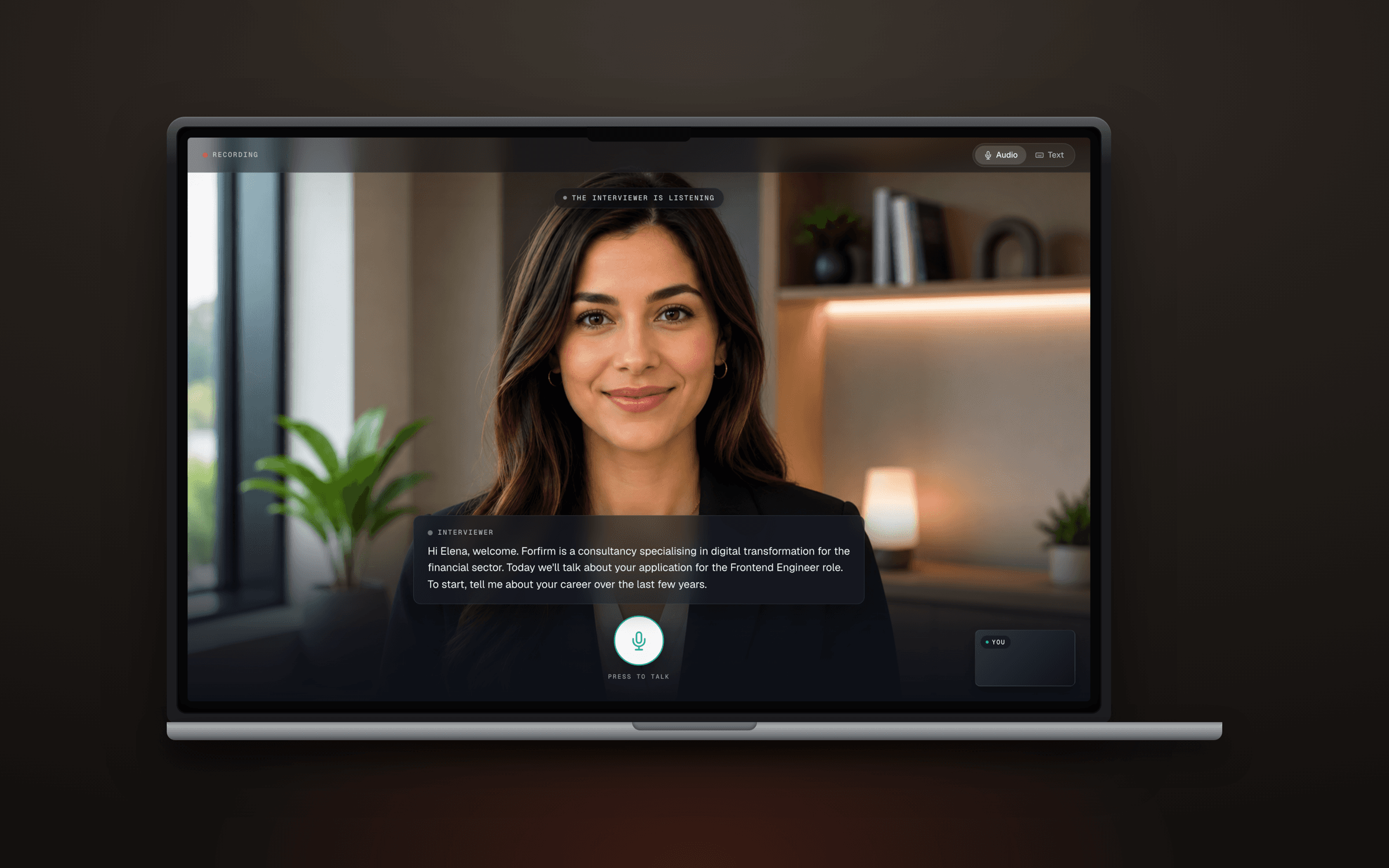
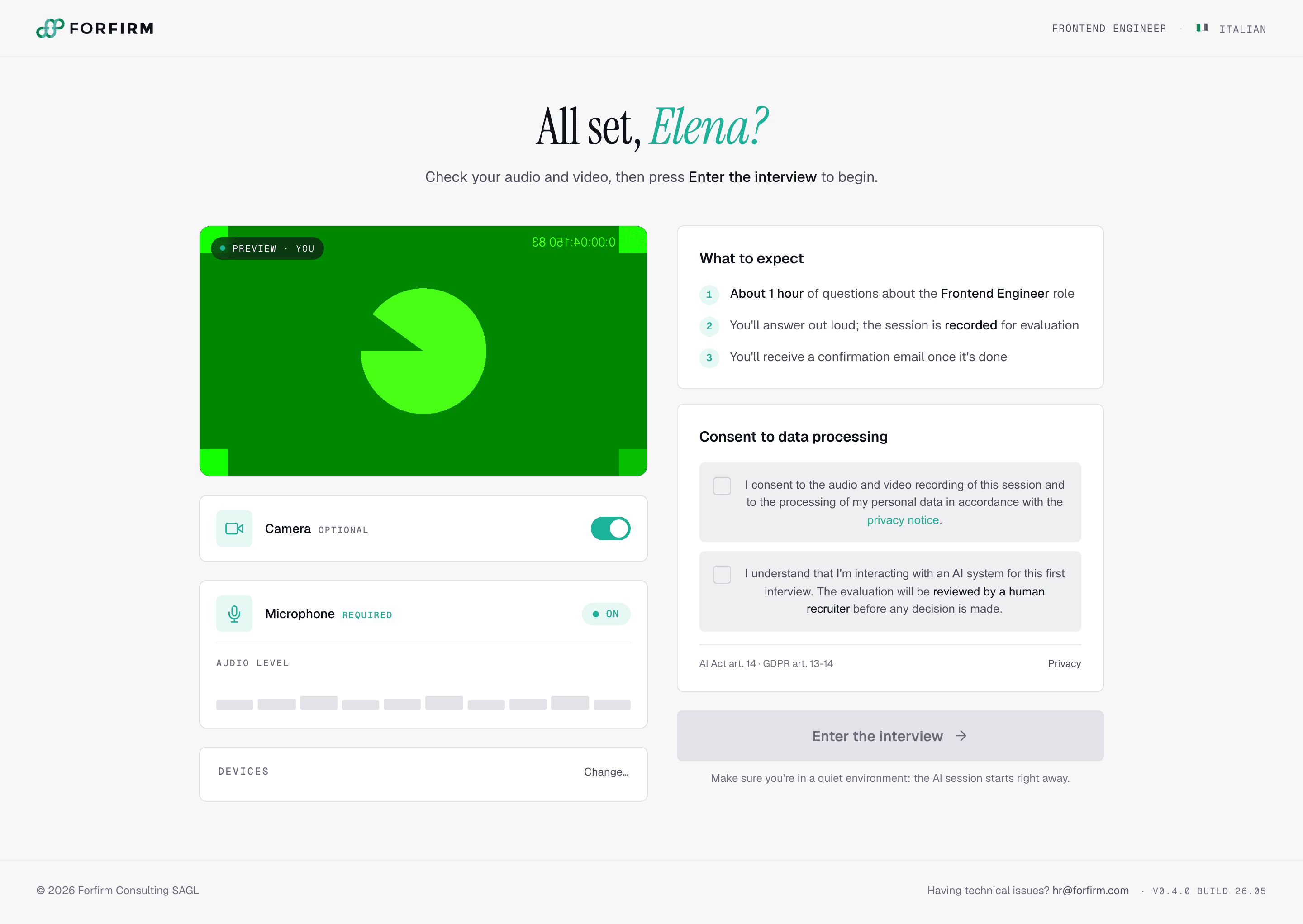
I designed the candidate side to feel like a normal first interview, not a test: a lobby to check the camera and give consent, then a conversation with an on-screen interviewer — a small frame for you, a larger one for the avatar, and the current question shown as text so nothing is missed.
- Lobby: device check, GDPR + AI-Act consent, and what to expect — no surprises.
- Turn-taking evolved from a push-to-talk button to natural handling of silences — “want to keep going?”, “can you still hear me?”.
- The voice engine and lip-sync avatar were built by an AI engineer; I designed the experience around them.
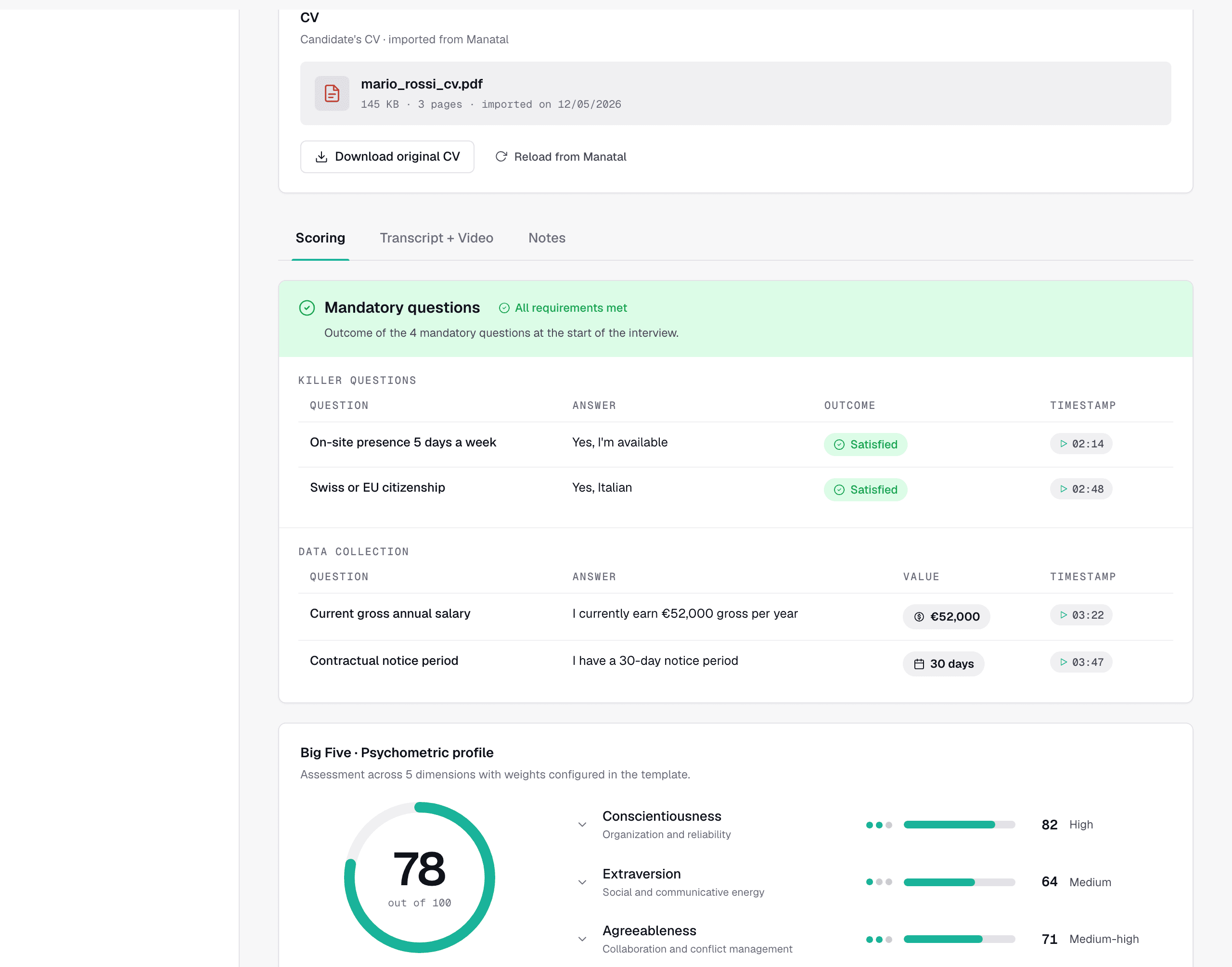
The payoff isn’t a recording nobody watches. When the interview ends, the recruiter is alerted and opens a structured review: the video, a transcript question by question, a per-question score rolled up into a weighted total, and an AI summary of strengths and weaknesses. The recruiter configures the interview; the hiring manager reads the result and decides.
- Video + transcript + per-question and weighted-total scores.
- An AI summary of strengths and weaknesses, with red flags surfaced.
- The candidate never sees a score — the human always decides.
Beyond design and frontend, I built the backend integrations that make ForFirm a product a team can actually adopt — it plugs into the tools they already use rather than replacing them. It also closed a real gap: only one interview can run per slot, and the ATS couldn’t book, so scheduling needed a home.
- Manatal (ATS): candidates, positions and CVs are pulled in, and the interview even cross-checks the CV against what’s said.
- Microsoft Bookings + Graph: scheduling and identity run through Microsoft — keeping our custom interview UI instead of a Teams bot.
Designed for change — because it changed twice.
- Build the frame, not just the picture
The question framework and the turn-taking model both changed mid-project — and were absorbed without rework, because the configuration was designed to flex rather than hard-coded.
- Language as a signal, not a setting
Letting the recruiter fix the interview language turned a preferences toggle into a real hiring signal — can this person work in this language?
- A human gate is a feature
The system prepares and proposes; a person always decides. That boundary is what makes an AI interview trustworthy.
- Fit beats replace
Slotting into Manatal and the Microsoft stack — rather than becoming one more tool to check — is what makes it usable day to day.