Concrete, Made Smarter
Making concrete smarter, not harder.
DMAT is an Italian deep-tech startup born from MIT research, focused on revolutionising concrete through a sustainable compound that improves durability and reduces CO₂. Their work blends materials science with advanced data modelling.
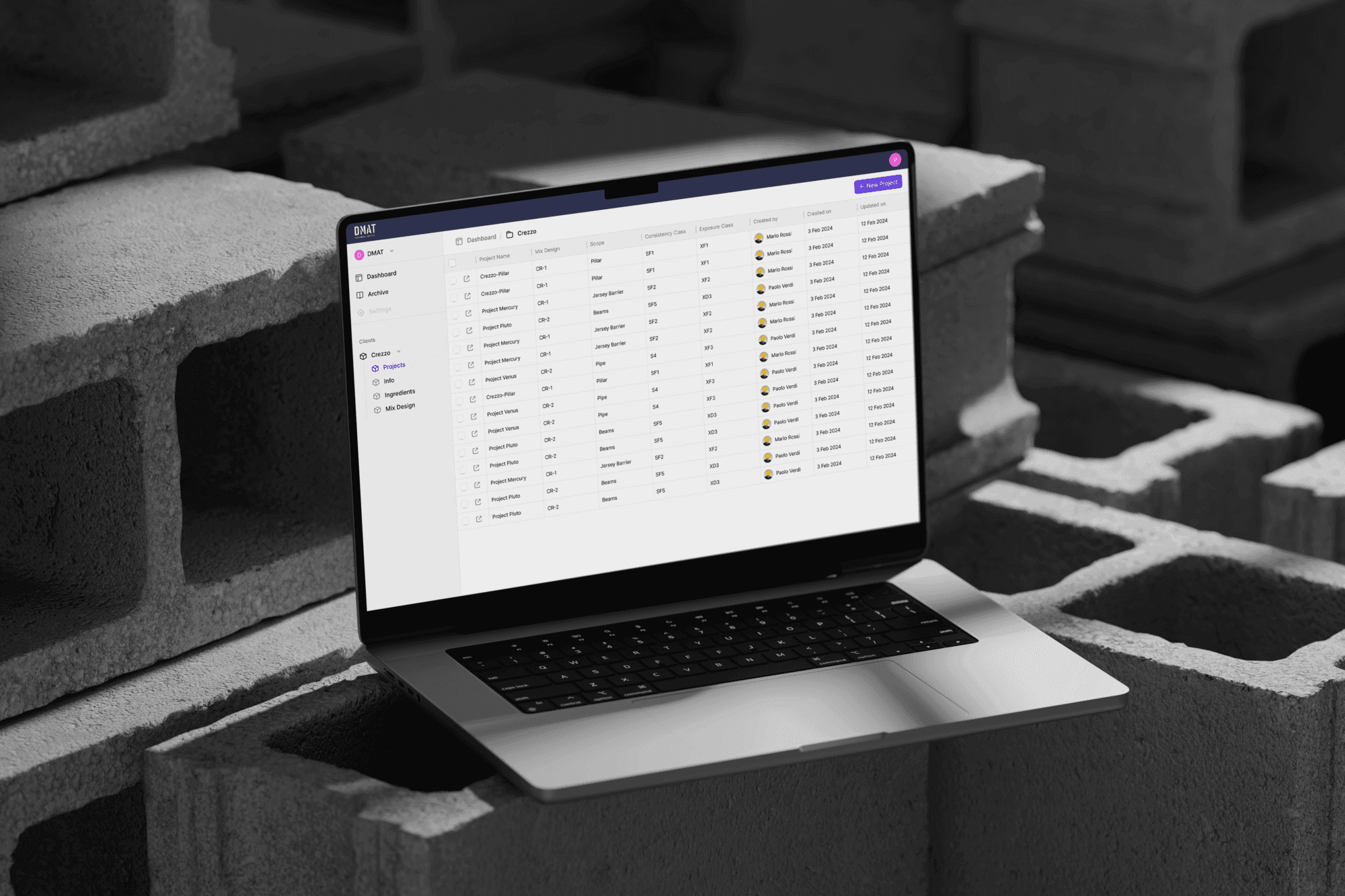
DMAT is a deep-tech startup born from MIT research, revolutionising concrete through a sustainable compound. They managed everything via Excel — client info, test results, product variations — and as operations grew that workflow became error-prone and inefficient; they also wanted to integrate predictive AI, but had no system to support it or make insights accessible across sales, engineers, and lab technicians. I designed a role-based platform that replaced the spreadsheets with guided, AI-assisted workflows.
- What it is — a role-based web platform for client data, concrete-mix design, lab testing, and AI predictions.
- My role — end-to-end UX ownership: stakeholder interviews, IA, a Figma design system, and usability testing.
- The result — PoC shipped May 2024, cutting redundant lab tests and data-entry time, and securing follow-on funding.
Everything ran on spreadsheets — client info, test results, product variations — manual, disconnected, and error-prone. As operations grew, the workflow buckled. One team member put it plainly: “I’m struggling to keep up with the volume of data we’re getting.” DMAT also wanted to bring predictive AI into the mix, but had no system to support it — or to make its insights legible to the very different people who’d rely on them: sales, engineers, and lab technicians.
I interviewed people across sales, the lab, and the technical team to find where the friction actually lived. Three distinct personas emerged — overlapping needs, but very different jobs to be done. Those conversations reframed the brief around three questions the whole team kept returning to:
- How do we tailor the interface to each user type without overwhelming anyone?
- How do we make AI predictions intelligible to people who aren’t data scientists?
- How do we unify proposals, tests, and results into a single system?
The answer was a single source of truth: the Mix Design Proposal. Every proposal is created by concrete experts, tested by lab technicians, reviewed by sales and admins, and enhanced by AI — so every team works from the same foundation instead of its own spreadsheet. A role-based platform replaced the files with guided, AI-assisted workflows, each user type getting a tailored view.
- A custom ingredient manager with dynamic supplier linkage
- A proposal engine with AI scoring (inference, confidence, cost, CO₂)
- A test-tracking dashboard with status-based workflows (pending, ongoing, complete)
- A reporting module that automatically generates PDF certificates
- AI components for scores, thresholds, and uncertainty, validated with lab technicians
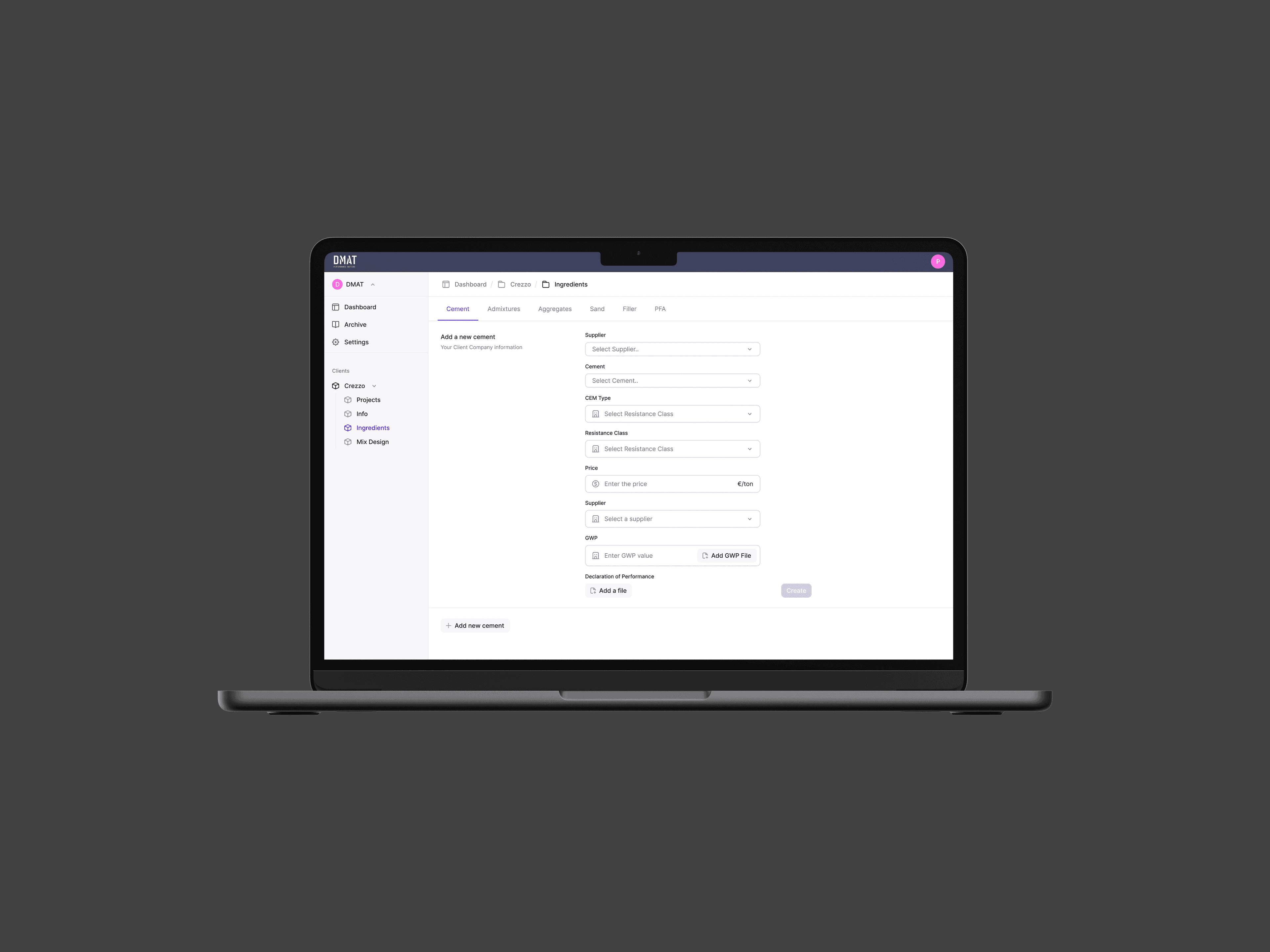
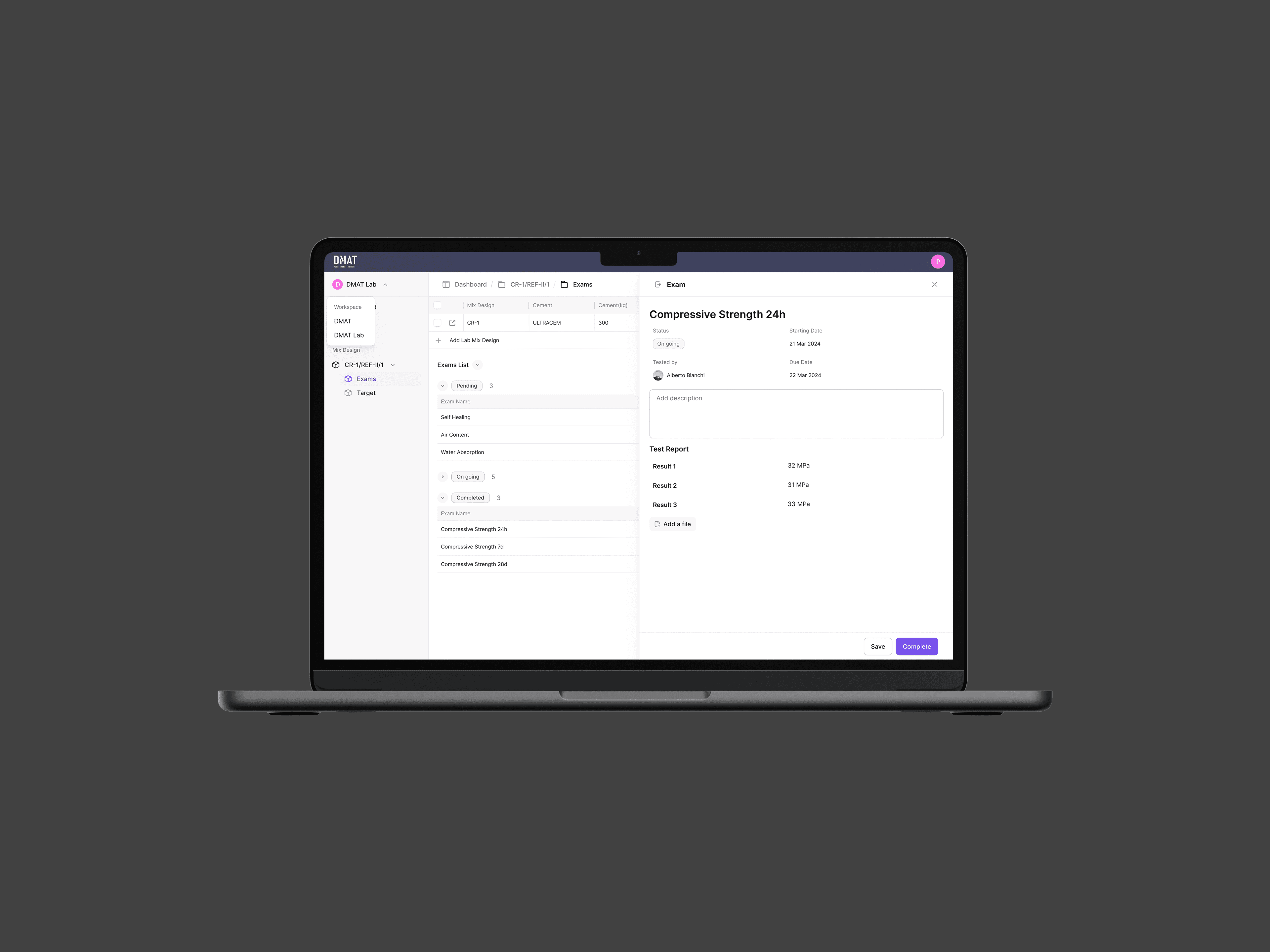
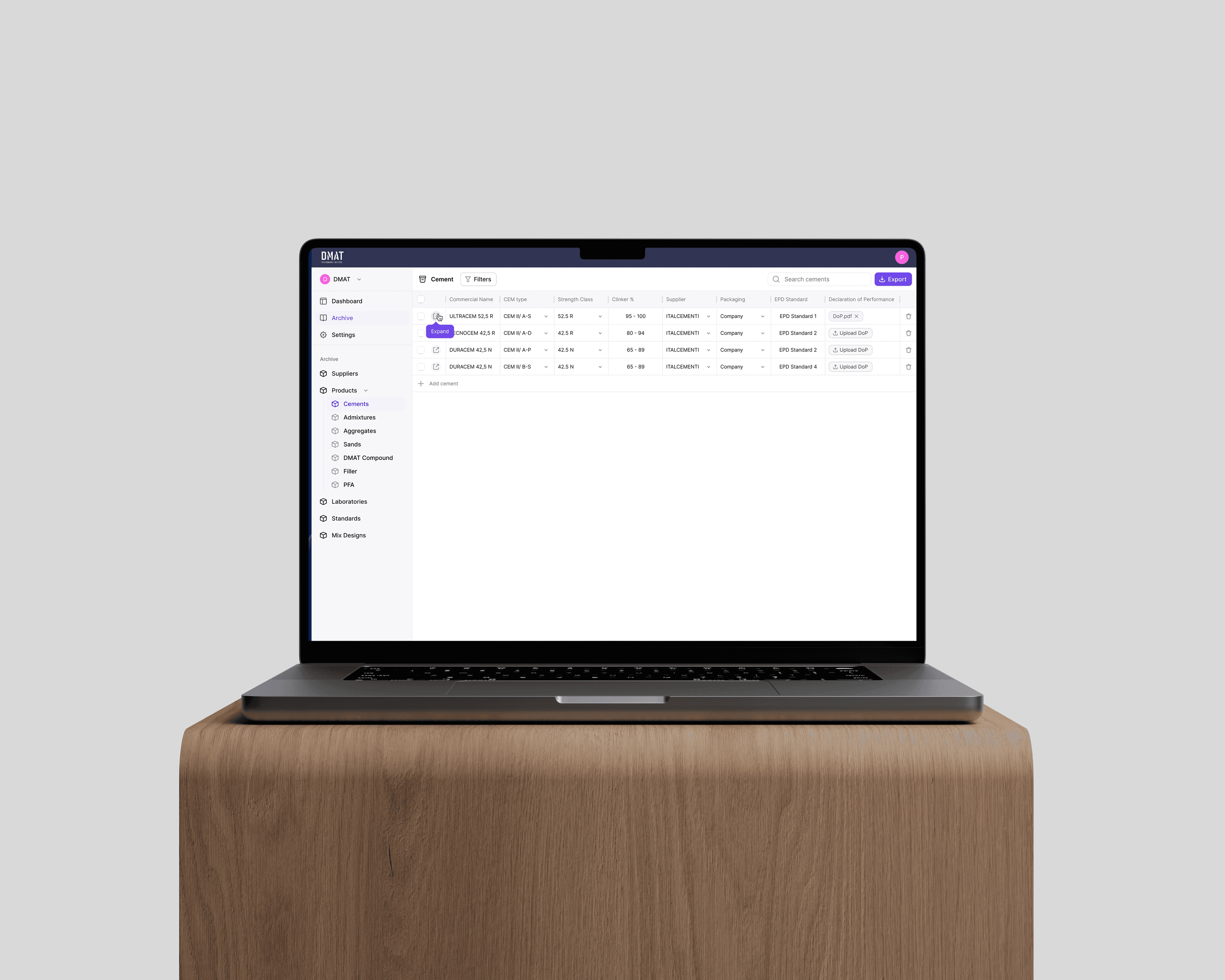

End-to-end UX ownership: stakeholder interviews, technical research, role-based information architecture, a design system in Figma, usability testing with lab technicians, and post-launch iteration. I collaborated directly with the AI engineer to visualise model predictions — designing components for inference scores, confidence thresholds, and CO₂ impact.
PoC shipped May 2024 — reduced redundant lab testing and secured follow-on funding.
- Fewer redundant lab tests
Redundant lab tests reduced an estimated ~20% via AI-powered proposal scoring.
- Faster data entry
Data-entry time cut from ~15 minutes (Excel) to under 5 — an estimated 67% reduction.
- Funding secured
Follow-on funding secured for full-scale development, directly supported by the PoC.
- A foundation to build on
Now the foundation for DMAT’s digital infrastructure as they expand into new markets.
The real challenge was always human — understanding what people needed to do their best work, and getting out of their way.
DMAT is building the future of concrete. I helped build the system that makes it possible.
- Don’t underestimate analog workflows. Replacing spreadsheets is harder than it looks — and far more rewarding.
- Design with confidence levels. The moment you introduce AI, people need to know how much to trust the output.
- Make complexity feel simple. Even the smartest system only works if it’s easy to use.
Want the full story, in my words?
Read it on Medium